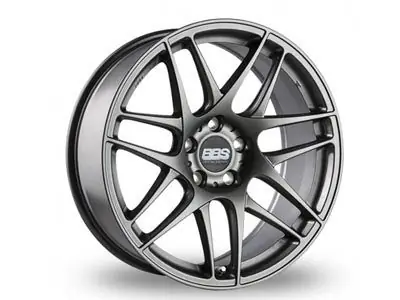
Cast one-piece
BBS CX wheels
The CX name appears in BBS's cast road range and is now best known through the CX-R. This page covers how to tell what you have, how it fits and how to look after a busy spoke pattern.
- Construction
- One-piece cast aluminium
- Later model
- CX-R
- Range
- BBS road wheel line
- Maker
- BBS
The CX and the CX-R
BBS's cross-spoke designs echo the mesh look that made the brand's name in the 1980s on wheels like the RS, translated into a single casting. The CX-R is a newer model in this style. The plain CX is less documented and we have not confirmed its exact design or years, so check the markings and compare photos when a listing uses the name. Do not assume a CX centre or cap will match a CX-R.
Why mesh looks need careful casting
A multi-spoke cross design has many thin sections meeting at nodes. Casting this well requires good mould design and control of the metal as it cools, otherwise you get porosity or weak points. That is one reason inexpensive mesh copies tend to be heavy: thicker sections cover for lower-grade casting. Genuine BBS castings tend to show crisp edges between spokes. Compare the back of a suspect wheel with a known genuine BBS if possible.
Cleaning a cross-spoke wheel
The many openings that make a cross-spoke wheel look good also trap brake dust. A routine that works:
- Wash when the wheels are cool.
- Rinse with a hose or pressure washer held at a sensible distance.
- Spray a non-acid wheel cleaner and leave it for the time on the label.
- Work through the gaps with a thin detailing brush, then a larger brush on the barrel.
- Rinse well and dry with a microfibre cloth or air blower.
A ceramic or polymer sealant makes the next wash much quicker. See caring for BBS wheels.
Fitment
Cross-spoke designs often have spokes that sit close to the caliper near the rim. Check clearance with a bare wheel before buying tyres, especially if your car has larger brakes than standard. Then check offset and width against your arches. Missing hub rings and the wrong bolt seat are the two usual problems with second-hand aftermarket wheels. The offset guide explains clearance calculations.
Inspecting used wheels
On a busy design, cracks can hide at the joins between spokes. Clean the wheels before inspecting them, then go round each node with a torch. Check the outer lip for kerb damage and the inner barrel for flat spots. Corrosion often starts in the corners between spokes where water sits. Light corrosion is cosmetic, but refinishing a mesh design costs more than a five-spoke because of the extra masking and prep.
Refinishing costs
Expect refurbishers to charge more for mesh and cross-spoke wheels than for simple designs. The extra time goes into stripping and painting all the inner faces evenly. Ask for a quote based on photos before committing, and confirm they will protect the markings on the back.
Hub rings and caps on cross-spoke designs
The centre section of a cross-spoke wheel is often quite deep, which makes centre caps more prominent. Lost caps are a common reason for buying replacement parts. Measure the cap opening and note how the original was fixed before ordering. Hub rings need care too. Plastic rings can deform with brake heat over years of use, so replace them if they are loose or cracked. Alloy rings last longer but can seize on the hub, so a little anti-seize on the hub spigot helps removal later.
Keep spare caps if you find them. They are easy to lose at tyre shops and can be awkward to replace.
Frequently asked questions
Is the CX the same as the CX-R?
No. The CX-R is a later model. Check markings and photos when matching wheels.
How do I clean a mesh-style BBS?
Use a non-acid cleaner and thin detailing brushes to reach between the spokes, then rinse and dry.
Are cross-spoke wheels harder to refurbish?
Yes, they take more preparation and usually cost more to refinish.
Is the CX forged?
No. It belongs to BBS's cast one-piece range.