
Practical guide
How to identify BBS wheels
Most BBS wheels can be identified in a few minutes if you know where to look. The back of the centre, the inside of the barrel and the centre cap carry most of the clues, and the construction itself narrows things down further.
- Main markings
- Back of centre, inner barrel, lip
- Model code
- Letters plus numbers, e.g. RS 041 style
- Size format
- Width J x diameter, e.g. 8Jx17
- Offset
- Marked ET plus a number in mm
- Other marks
- Approval stamps, date code, OEM part number
Start with the construction
Before reading any stamps, look at how the wheel is built. That alone tells you which family to search.
- A ring of small bolts around the face or the lip means a two-piece or three-piece wheel. On a three-piece wheel you will see a joint line between the outer lip and the inner barrel as well.
- No visible assembly bolts and a smooth, continuous barrel means a one-piece wheel, either cast, flow-formed or forged.
- A mesh centre with cross spokes points toward designs such as the RS, RS-GT, RX, RT or LM. Spoke designs point elsewhere in the catalogue.
Some designs look alike from the front. A one-piece cast mesh wheel and a three-piece RS can be confused in photos, but the assembly bolts settle it straight away.
Markings on the back of the centre
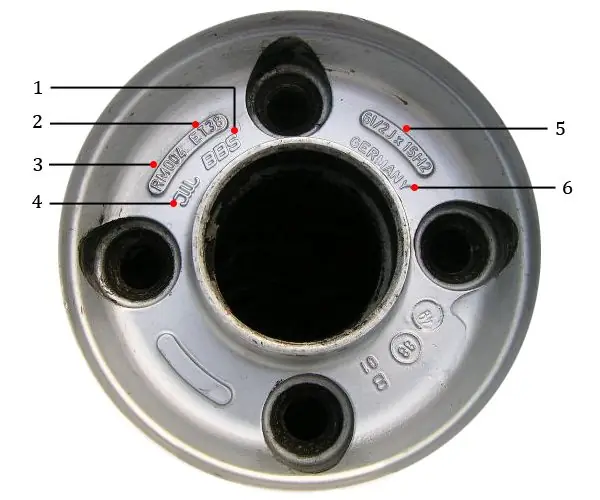
Turn the wheel over. On most BBS wheels the casting or forging on the back of the spokes or the hub carries raised or stamped text. You will usually find several of these:
- The BBS name or logo, often cast in.
- A model or part code. Older German wheels typically use a short letter prefix followed by a three-digit number, and the prefix often matches the series name (RS, RA, RG, RC and so on).
- The size, written as width and diameter, for example 7.5J x 17. The J refers to the bead seat profile, and the width is measured between the bead seats in inches, not across the outside of the lip.
- The offset, marked ET followed by a number in millimetres, such as ET35.
- Approval marks. German wheels often carry a KBA number used for road approval paperwork. Japanese wheels frequently carry JWL and VIA marks.
- A date code, sometimes a small clock-style dial with an arrow, or a month and year.
- On factory wheels, the carmaker's part number and sometimes the carmaker's logo next to the BBS mark.
Write all of this down before cleaning, as dirt and old paint can be removed with the text if you are heavy handed.
Multi-piece wheels have more than one set of numbers
On a three-piece wheel the centre, the outer lip and the inner barrel are separate parts, and each may carry its own marking. The centre code tells you the design and diameter. The lip and barrel are often stamped with their own widths. Because owners have swapped lips and barrels for decades, the numbers on the centre do not always match the wheel as it sits today.
That has a direct effect on offset. A centre marked with one ET figure may now be built into a different width, giving a different real offset. Measure it yourself if it matters (the fitment guide shows how). Also check whether all four wheels in a set are built the same way, because staggered or mismatched builds are common.
Centre caps and badges
Caps are useful but easy to fake and easy to move between wheels. Genuine caps on classic multi-piece wheels are usually separate parts held in by clips or small screws and carry a BBS logo, sometimes with a coloured background. Some OEM wheels have the carmaker's cap instead. The LM and other Japanese forged wheels often have a distinctive cap design that is copied widely.
Treat a cap as a supporting clue. A wheel with a BBS cap and no BBS markings on the back is almost certainly not genuine. A genuine wheel with a missing or aftermarket cap is common and not a problem in itself.
Lip and spoke stickers, and why they mislead
Many BBS wheels left the factory with a small badge or decal on a spoke or the lip. These are copied by the thousand and sold separately online, so their presence proves nothing. On the other hand, real wheels are often refinished and lose them. Ignore stickers when deciding what a wheel is, and rely on cast or stamped text.
Factory wheels with BBS origins
A large number of BBS-made wheels were sold as original equipment. These usually carry the carmaker's part number and logo prominently, with a smaller BBS mark or name elsewhere on the back. Some owners do not realise their factory wheels are BBS. Others assume every mesh factory wheel is BBS when it was made by a different supplier. The only reliable test is the marking on the casting.
OEM BBS wheels can have different offsets and centre bores from the aftermarket version of a similar design, because they were built for one car. Check the ET and bore before fitting them to something else.
Recognising copies
Copy wheels copy the look of popular BBS designs, the mesh multi-piece wheels and the LM in particular. Signs to look for:
- No BBS text on the casting, or text that looks shallow, blurred or badly spaced.
- Fake assembly bolts. On many one-piece copies the bolts around the lip are decorative and screw into blind holes, or are moulded in.
- Missing approval marks, or approval marks from bodies that do not match the claimed origin.
- Unusually heavy weight for the size compared with published figures for the genuine wheel.
- Spoke shapes and windows that are slightly off, especially where the mesh spokes meet the hub.
The buying used guide goes deeper into fakes and the questions to ask a seller.
Measuring when the markings are gone
Heavily refurbished wheels sometimes lose their stamps. In that case measure:
- Diameter and width at the bead seats, not the outer lip edge. Outer lip width is usually about an inch larger than the nominal width.
- Bolt pattern (PCD): on a five-stud wheel, measure from the centre of one hole to the outer edge of the hole furthest from it as an approximation, or use a PCD gauge.
- Centre bore diameter with callipers.
- Offset: lay a straightedge across the back of the wheel, measure backspacing to the mounting face, then calculate ET as explained in the fitment guide.
With size, PCD and the centre design in hand, comparing against the model pages in the catalogue usually narrows it down to one series.
German and Japanese wheels compared
Wheels made in Germany and wheels made in Japan under the BBS name tend to be marked differently. German wheels commonly show the model code, size, ET and a KBA approval number, and the text is often cast in raised letters. Japanese wheels, especially the forged ones, more often carry JWL and VIA marks, a forged or Japan stamp, and sometimes a laser-etched or machined code rather than raised casting.
Some designs were sold only in one market, and some shared a name but differed in detail between markets. If a wheel's markings do not match what you expect for a German-made example, check whether it may be a Japanese-market version before assuming it is a copy. The model pages in the catalogue note where a design was mainly sold when that is known.
Common mix-ups
A few confusions come up again and again. The RS and RS-GT look alike, but the RS-GT is a later design with different spoke shapes and fitments. The one-piece RX and RT imitate the mesh look of the multi-piece wheels, and photos taken from a distance make them easy to mistake for three-piece wheels. The RS II is a two-piece design with a forged centre, so it shows assembly bolts but no separate inner barrel joint like a classic three-piece RS.
When in doubt, photograph the back of the wheel in good light and compare it with known genuine examples rather than relying on the face.
A quick checklist
- Count the pieces: look for assembly bolts and joint lines.
- Read the back of the centre: model code, size, ET, approvals, date.
- Check each part of a multi-piece wheel separately.
- Use the cap as a clue, never as proof.
- Ignore stickers.
- Measure if the markings are gone or do not match.

Frequently asked questions
Where is the model number on a BBS wheel?
Usually on the back of the centre, cast or stamped near the hub or on the back of a spoke. Multi-piece wheels may have extra numbers on the lip and barrel.
What does ET mean on a BBS wheel?
ET is the offset in millimetres, the distance from the wheel's centreline to the hub mounting face. A higher number puts the wheel further inside the arch.
Does a BBS centre cap mean the wheel is genuine?
No. Caps are sold separately and copied widely. Look for BBS markings cast into the wheel itself.
Can a factory wheel be a BBS?
Yes. Many carmakers fitted BBS-made wheels. They usually show the carmaker's part number and a BBS mark on the back.