
Restoration guide
Refurbishing three-piece BBS wheels
A three-piece wheel can be taken apart, and that is both its advantage and its risk when refurbishing. Each part can be refinished properly and worn parts replaced, but the wheel has to be resealed and reassembled to the right torque or it will leak air or worse.
- Parts
- Centre, outer lip, inner barrel, assembly bolts
- Seal
- Silicone-type sealant or O-ring, design dependent
- Typical finishes
- Paint or powder centre, polished or anodised lips
- Main risks
- Leaks, wrong torque, overheated alloy
- Key test
- Pressure leak test after assembly
How a three-piece wheel is built
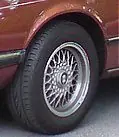
A classic three-piece BBS wheel such as the RS has a cast centre, a spun aluminium outer lip and a spun inner barrel. A ring of assembly bolts passes through all three and clamps them together. The joint between the lip and barrel is sealed so the wheel holds air, because the tyre seals against the rim, not against an inner tube.
The arrangement makes refurbishment easier in some ways. The centre can be painted without masking the lips, lips can be polished on a lathe without spoke detail in the way, and a kerbed lip can be swapped for a new one. In other ways it is harder, because it introduces a seal and dozens of fasteners that must all be correct. A badly rebuilt three-piece wheel can look perfect and still lose pressure slowly for months.
Before you start: assess the wheels
Inspect each wheel before committing money to it.
- Check the centre carefully for cracks, especially around the bolt holes, where spokes meet the hub, and at the outer ends of the mesh where it meets the assembly bolt ring. A cracked centre is usually scrap.
- Look at the inner barrel for dents and the outer lip for kerb damage. Minor kerb marks can be polished out. Deep gouges or bends may need a replacement lip.
- Check that assembly bolts turn without seizing. Corroded bolts may snap during dismantling.
- Record all markings and measure the current offset (see the fitment guide). This is the moment to change widths if you want to, by buying different lips or barrels.
A wheel that has been straightened before is not automatically a problem, but repeated straightening of the same area weakens it. The used buying guide has more on spotting this.
Dismantling
Remove the tyre and the valve first. Mark the position of every component with a paint pen or by photographing each wheel, so the parts go back in the same orientation. Some refurbishers keep each wheel's parts together in its own box, which avoids mix-ups when lips differ slightly.
Undo the assembly bolts in a cross pattern a little at a time. Corroded bolts benefit from penetrating oil and patience. Heat can help but must be used carefully, because aluminium alloys lose strength if overheated. Once the bolts are out, the parts are often still stuck together by old sealant. They are separated with a soft mallet or gentle levering, never by prying hard against the sealing faces.
Stripping and cleaning
Old sealant has to be removed completely from the mating faces. Any residue can stop the new seal from forming. Paint on the centre is typically removed by chemical stripping or media blasting. Blasting media and pressure should be chosen with care, as aggressive media can pit soft alloy and round off fine detail on the mesh spokes.
Lips and barrels are often bare polished aluminium or have a clear or anodised finish. Chemical stripping followed by polishing usually suits these better than blasting, which leaves a dull surface that is hard to polish back.
Inspect the bare parts again once clean. Small cracks that were hidden by paint and dirt often become visible at this stage, and dye penetrant testing is an inexpensive way to check doubtful areas.
Refinishing the centre
Centres are usually painted in wet paint or powder coated. Powder coating is tough and popular but is cured in an oven, typically around 180 to 200 degrees Celsius for a set time. Most refurbishers consider that acceptable for cast aluminium centres, but magnesium parts and some expert wheels should not be cured at high temperature. If you are unsure what alloy a centre is made from, ask the refurbisher how they will handle it.
Thickness matters too. Thick coatings on the mounting face and in the bolt holes change how the wheel clamps to the hub and can let fasteners loosen. A good shop masks the mounting face, the seat areas and the mating surfaces where the centre meets the lip and barrel.
Classic colours include gold, silver and white. Diamond-cut or machined faces need a lathe and a clear coat afterwards.
Lips and barrels
Polished lips are polished by hand or on a lathe, then often clear coated or left bare. Bare polished aluminium looks best but needs regular care to avoid dulling. Clear coat protects it but eventually yellows or lifts, and repairing lifted clear coat means stripping it again.
Replacement lips and barrels are available for some popular designs from BBS or from independent makers. Independent parts vary in quality. Ask how they are made, whether they are spun from the correct alloy, and whether they are designed to carry the loads of the original. Changing lip or barrel widths changes the wheel's offset, so work out the new figure before ordering.
Hardware
Assembly bolts and nuts on BBS three-piece wheels are high-strength parts made for the job. Reusing heavily corroded ones is not advisable, and replacing them with generic bolts of unknown grade is dangerous. Many owners fit new sets of the correct type during a rebuild. Titanium or decorative bolt sets are sold too; if you use them, make sure they are rated for the clamping load and suit the design.
Washers, and in some designs small bolt caps, should be renewed as well. Check that thread lengths and head shapes match the original.
Sealing and assembly
Most classic BBS three-piece wheels are sealed with a bead of silicone-type sealant applied to the joint between lip and barrel, either during assembly or on the inside of the joint afterwards, depending on the design and the shop's method. Some later designs use O-rings. Use a sealant that is meant for wheel assembly and that stays flexible.
Assembly bolts are tightened in a cross pattern in several stages to the specified torque. The torque figure is design specific and should come from BBS or an expert who has it for that wheel. Too little and the joint can shift and leak. Too much and bolts can stretch or the soft alloy beneath the heads can crush. Many shops use a thread locking compound as specified for the design.
Testing
Every rebuilt wheel should be leak tested before the tyre goes back on the car. A common method is to fit the tyre, inflate above normal running pressure and submerge the wheel in a tank or spray the joint with soapy water to look for bubbles. Leaks are usually at the lip joint, the valve or the bead. The wheel should also be checked for runout on a balancing machine. A centre that is slightly off after assembly shows up here.
After fitting, recheck pressures daily for the first week. A slow leak is easier to fix before the wheel has done many miles.
Choosing a refurbisher
Many wheel shops can paint a one-piece wheel. Fewer understand multi-piece wheels well. Ask:
- Do they dismantle three-piece wheels fully or paint them assembled?
- What sealant and hardware do they use, and do they renew the hardware?
- How do they handle curing temperatures for powder coat?
- Do they leak test every wheel?
- Can they show examples of BBS wheels they have rebuilt?
A shop that paints three-piece wheels without dismantling them can produce something that looks fine, but paint bridges the joint and the seal and fasteners are not inspected.
Doing it yourself
Cosmetic work such as cleaning, polishing bare lips and touching in small chips is within reach of a careful owner. Full dismantling and resealing is possible at home too, but it needs a good torque wrench, the correct torque figures and sealant, a way to strip and refinish the parts, and access to a tyre machine and balancer. The cost of tools and the risk of a mistake mean many owners do the preparation and polishing themselves and leave assembly and testing to an expert.
If you do assemble wheels yourself, work on one wheel at a time, keep notes of torque and sequence, and have every wheel leak tested and balanced before it goes on the car.
Frequently asked questions
Can three-piece BBS wheels be powder coated?
Usually the cast aluminium centres can, with masking of mounting and mating faces. Magnesium parts and some special alloys should not be cured at high temperature.
Why does my rebuilt three-piece wheel leak?
Common causes are old sealant left on the mating faces, uneven bolt torque, a damaged lip edge or a worn valve. A soapy water test usually shows where.
Should I reuse the assembly bolts?
Only if they are in good condition. Many rebuilders replace them as a matter of course, and generic bolts of unknown grade should never be used.
Can I change the width of a three-piece wheel?
Yes, by fitting different lips or barrels, which also changes the offset. Calculate the new ET before ordering parts.