
Buyer's guide
Buying used BBS wheels in the UK: local checks
Second-hand BBS sets come up across the UK on eBay UK, Gumtree, Facebook Marketplace and PistonHeads, in owners' clubs and forums, and at shows and autojumbles. Plenty arrive from Japan or the EU. The usual dangers apply everywhere: copies, cracks, bad repairs and the wrong size. In Britain, winter roads, import charges and your insurer add a few more things to check.
- Biggest risks
- Copies, cracks, poor repairs, wrong sizes
- Check first
- Markings on the back of every wheel
- Inspect
- Spoke roots, bolt holes, barrel, lip
- Test
- Spin on a balancer for runout
- Paperwork
- Approval documents may matter in some countries
Buying used BBS wheels in the UK
Work through the global checklist first: markings on every wheel, cracks at spoke roots, bolt holes and barrel, and extra care with anything welded. The UK steps below come after that.
Where to look
Sets are listed on eBay UK, Gumtree, Facebook Marketplace and PistonHeads classifieds, and in owners' club and forum sales sections. Club members can usually tell you which cars a set has been on and who rebuilt it. Shows such as Japfest, Ultimate Stance and Players often have wheels for sale too, which lets you inspect a set before you pay.
Sets from the EU and Japan
Many good sets are in Germany or Japan. Since Brexit, buying from the EU may add VAT and handling charges when the wheels arrive, so find out what the total will be before you commit. Ask for photos of the back of each wheel, the whole inner barrel and the bead seats, and a video of each wheel spinning on a balancer if possible. Check the wheels as soon as they are delivered and before tyres are fitted. Japanese-market wheels are marked differently from German ones, so judge them against the identification guide.
MOT and insurance
The UK has no approval process for aftermarket wheels, but the car must stay roadworthy. At the MOT, a wheel that is cracked or distorted, a missing or loose nut or bolt, a tyre with under 1.6 mm of tread across the central three-quarters, or a tyre fouling the bodywork or suspension is a failure. Wheels shouldn't stick out past the bodywork in a way that makes the car unsafe. New wheels are also a modification to declare to your insurer, and leaving them off can void your cover. Have the size, offset, PCD, centre bore and load rating to hand; the fitment guide explains each figure.
Wear to look for here
- Corroded polished lips and furry bolt heads from winters on salted, gritted roads.
- Bent lips and dented barrels from potholes, especially on sets that ran low-profile tyres.
- Corrosion creeping under chipped paint on the centres.
- Old tyres. Check the DOT date code, since rubber can harden while still looking fine.
If a three-piece set has badly corroded hardware, plan for a full rebuild. The refurbishing guide explains the work, and on a classic like the RS it is often money well spent.
Decide what you are buying first
Before looking at listings, know the exact size, PCD, offset range, centre bore and seat type your car needs. The fitment guide explains each number. Many disappointing purchases are genuine wheels in good condition that simply do not fit, or need adapters, spacers and different bolts that add cost and compromise.
Also decide whether you want a wheel to use daily or a collector piece. Rare sizes of classic three-piece wheels such as the RS command high prices, and a set that needs a full rebuild may still be worth it for a restoration. For a daily car, a sound one-piece wheel like a CH or CK may be far less costly to own.
Copies and fakes
Popular BBS designs have been copied heavily. Some copies are sold openly as styled or inspired wheels, which is legal in many places; the problem arises when they are resold as genuine. Copies of mesh multi-piece wheels and of the LM are especially common.
Signs that a wheel is not genuine:
- No BBS name, model code, size and ET on the back of the centre, or text that is shallow, blurry or oddly spaced.
- Fake rivets or assembly bolts on a one-piece casting. Try to see behind the bolt heads; on many copies there is no nut or the bolt is moulded in.
- Approval marks missing or inconsistent with where the wheel was supposedly made.
- Weight noticeably above published figures for the genuine size.
- Spoke profiles, window shapes and lip steps that do not match photos of known genuine wheels.
- A price that is much lower than comparable sets.
Stickers and centre caps prove nothing either way, since both are sold separately. The identification guide covers markings in detail.
Questions to ask the seller
- Can you send clear photos of the back of each wheel, including the markings?
- Have the wheels been refurbished, straightened or welded, and by whom?
- Do they hold air without topping up?
- Were they balanced recently, and did any need a lot of weight?
- For multi-piece wheels, have they been dismantled, and were lips or barrels changed?
- What car were they last on?
Vague answers are not proof of a problem, because many sellers simply do not know a wheel's history. They are a reason to inspect in person or budget for repair.
Finding cracks
Cracks are the most serious defect and the one most likely to be hidden. They tend to start where stress concentrates:
- At the roots of the spokes where they join the hub or the rim.
- Around wheel bolt holes and the centre bore.
- On the inner barrel, often near the bead seat, after hard pothole impacts.
- On multi-piece wheels, around the assembly bolt holes in the centre.
Clean the wheel and look closely with a torch at a low angle. Fresh paint can hide a crack, and a heavy coat of powder over a previously welded area is a warning sign. Dye penetrant kits are inexpensive and reveal fine cracks well. A crack in a spoke or the centre usually means the wheel should be scrapped. Cracks in the barrel are sometimes welded, which leads to the next question.
Straightened and welded wheels
Bent wheels are common, and straightening is a normal repair. A wheel with a slight bend at the inner lip can often be returned to true by a competent shop with the right equipment. Problems start when wheels are straightened repeatedly, heated aggressively, or bent far beyond a small deformation. Aluminium alloys become harder and more brittle where they are worked, and overheating can permanently reduce strength.
Welding a crack is more controversial. Cast aluminium can be welded, but the area around the weld loses some of its heat treatment, and many experts and carmakers advise against welding structural cracks in road wheels at all. A welded barrel on a show car that is driven gently is a different case from a welded wheel on a heavy daily car. Ask for full disclosure and price the wheel as a part that may need replacing.
Signs of repair include uneven paint texture on the barrel, grinding marks, bulges or flat areas near the bead seat, and a ring of new paint on one section of an otherwise original finish.
Checking for bends and runout
The best check is a balancing machine. Fit each wheel without a tyre if possible and spin it while watching the inner and outer bead seats. Radial runout (up and down) and lateral runout (side to side) show as movement against a pointer or gauge. Small amounts are normal. A visible hop or wobble needs investigating.
Without a balancer, roll each wheel on a flat floor and sight along the lip, or lay it face down on a flat surface and check for gaps. These are rough tests but they catch serious damage.
Multi-piece specifics
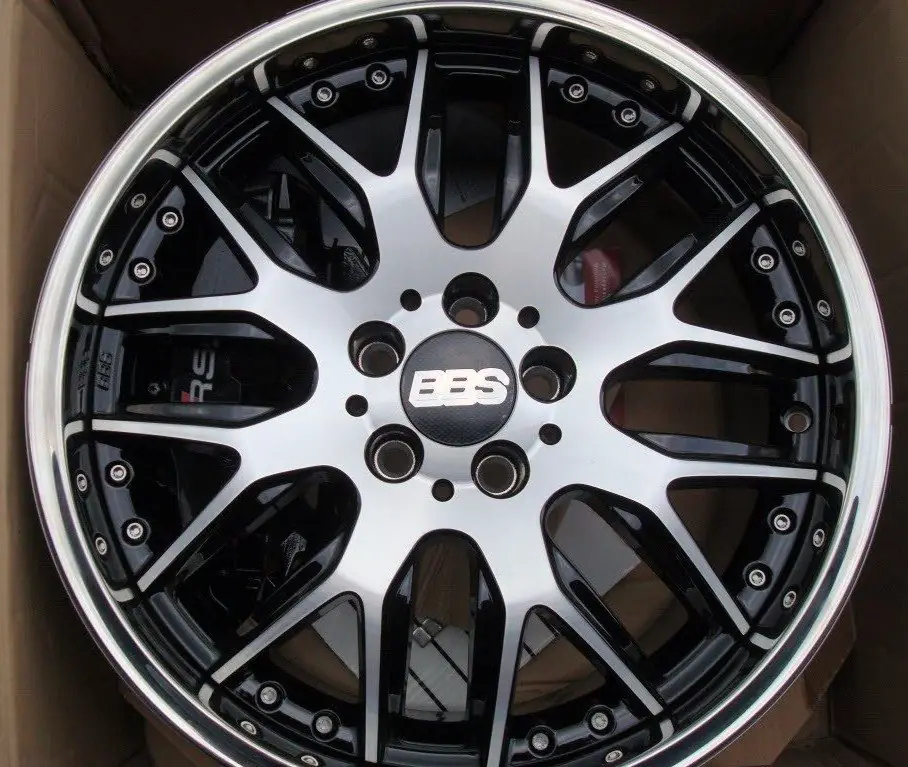
Three-piece and two-piece wheels add their own checks. Look at the condition of the assembly bolts: heavy corrosion suggests the wheel has never been dismantled and will need a full rebuild with new hardware and sealant. See whether all wheels in a set carry matching lip and barrel stamps, or whether parts have been swapped. Measure each wheel's actual offset rather than trusting the centre stamp. And check the joint between lip and barrel for signs of leaking sealant or recent resealing.
The refurbishing guide describes what a proper rebuild involves, which helps you price one.
Tyres, centre caps and extras
Tyres on used wheels are often old even when the tread looks good. Read the DOT date code on the sidewall (the last four digits give week and year). Tyres several years old may be hard and should not be counted as value. Missing centre caps can be expensive for some older designs. Original bolts, hub rings and locking bolt keys add value if they come with the set.
In some countries, aftermarket wheels need approval paperwork for road use, such as the German ABE or a TÜV entry. If that applies where you live, ask for the documents or check whether they can still be obtained.
Pricing a set honestly
Add up what the set will really cost: purchase price, transport, refurbishment, new hardware, sealing, tyres, bolts, hub rings and any approval or inspection. A inexpensive set needing a full three-piece rebuild can end up costing more than a sound set at a higher price. Equally, a fairly priced set with one cracked centre is a set of three until you find a replacement, and finding one centre in the right size and finish can take a long time.
Buying at a distance
Many sets are sold online, often by private sellers far away. If you cannot inspect in person, ask for close-up photos of each wheel's back, the inner barrel all the way round, the bead seats and any repaired areas. A short video of each wheel spinning on a balancer is even better. Ask for the weight of one wheel if you know the published figure for the genuine size.
Pay with a method that offers some protection, and agree in writing what condition is being described. Arrange proper packing for shipping, as wheels damaged in transit are a common source of disputes. When the set arrives, inspect it promptly and before fitting tyres, so any problem can be raised while the seller is still easy to reach.
When to walk away
Some findings should end the conversation. A crack in a spoke or the centre, a wheel that leaks from a weld, markings that do not match the claimed model, or a seller who will not show the back of the wheels are all good reasons to keep looking. Plenty of sound BBS sets come up for sale, and patience usually costs less than repairing a bad one.
Frequently asked questions
Where can I buy used BBS wheels in the UK?
Private sellers list them on eBay UK, Gumtree, Facebook Marketplace and PistonHeads, and owners' clubs and forums have sales sections. Car shows and autojumbles are good for seeing a set in person. Club sellers tend to know the most about a set's history.
Do I have to tell my insurer about a used BBS set?
Yes. Aftermarket wheels are a modification, and an undeclared modification can void your cover. The car also has to stay roadworthy for the MOT, so check the fitment and the tyres before the wheels go on.
What extra costs come with buying wheels from the EU?
Since Brexit, wheels bought from an EU seller may attract VAT and handling charges on arrival, on top of shipping. Ask the seller how the set will be sent, agree the condition in writing and inspect every wheel before tyres are fitted.
How can I tell if used BBS wheels are fake?
Check the back of each centre for proper BBS text, model code, size, ET and approval marks, and look for fake assembly bolts on one-piece copies. Caps and stickers prove nothing.
Is a straightened BBS wheel safe?
A single, competent straightening of a minor bend is a normal repair. Repeated straightening, heavy heating or large bends are reasons for caution.
Should I buy a welded wheel?
Many experts advise against welding structural cracks in road wheels. If you buy one, treat it as a wheel that may need replacing and avoid it on heavy or hard-driven cars.
What is the most important check on used wheels?
Looking for cracks at spoke roots, bolt holes and the barrel. A cracked centre is usually not repairable.