RF in the UK
BBS RF cast mesh wheels in the UK
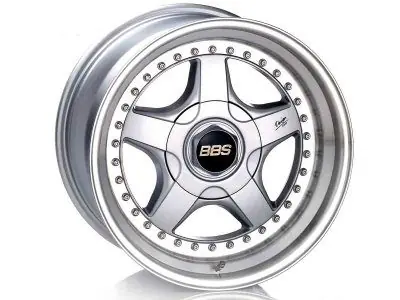
The BBS RF put the cross-spoke mesh on a one-piece casting, and our records list 16 part numbers from 15 to 17 inches. Nearly all of them were made for German cars that sold in large numbers in Britain: the BMW 3, 5 and 7 Series, Volkswagen Golf and Passat, Audi 80, 90 and 100, and Mercedes-Benz models.
- Construction
- One-piece cast aluminium
- Design
- Cross-spoke mesh with a flat or shallow face
- Era
- 1990s, with production details varying by market
- Typical diameters
- Mostly smaller diameters suited to cars of the period; sizes varied by market
- Typical cars
- European compact and mid-size cars, often VW and BMW
- Lip
- No separate lip; the rim and face are one casting
The BBS RF in the UK
The RF table reads like a list of cars that filled British driveways in the late 1980s and 1990s. 4x100 sizes such as RF009, RF014 and RF015 are listed for the early BMW 3 Series and the VW Golf 2, Golf 3 and Passat. 5x120 sizes such as RF004 and RF010 are for later BMW 3, 5 and 7 Series. Mercedes-Benz and Audi get 5x112 sizes, RF005 among them. Centre bores vary as well, so check both figures against your car.
Finding a set
RFs come up on eBay UK, Gumtree and Facebook Marketplace, in BMW, VW and Mercedes owners' club classifieds, and at autojumbles. Sets also come from Europe and Japan; an EU purchase may now attract import VAT and handling charges. Ask for photos of the markings on the back of every wheel before paying, and inspect the rim edge and spoke roots on arrival. A set with one wheel in a different finish has probably had a replacement, which is fine if it is genuine and the same size. See buying used BBS wheels and identifying BBS wheels.
Winter roads and refinishing
Each crossing on a mesh face is a small pocket where brake dust and road salt collect, and once the paint chips, corrosion starts there. An RF that has done decades of British winters will often show bubbling at the crossings and on the inner barrel. Potholes add bent lips. A careful refinisher using thin coats keeps the mesh edges crisp; the refurbishing guide covers what to ask for.
Fitting, MOT and insurance
On a period BMW or Golf, an RF in the original size is an easy fit. Newer cars are harder, with bigger callipers and often a different bolt pattern. The UK has no approval scheme for aftermarket wheels, but the MOT checks wheels for cracks and distortion, wheel bolts for security, and tyres for tread and clearance. Let your insurer know about the wheels. The offset guide helps with sizes. Related wheels: the RG and the three-piece RS.
Where the RF fits in the BBS range
BBS, founded in 1970 in Schiltach by Heinrich Baumgartner and Klaus Brand, built its reputation on multi-piece racing wheels. By the 1980s its road wheels, led by the three-piece RS, were among the most recognised aftermarket wheels in Europe. They were also expensive, and a three-piece wheel needs more care than many owners wanted to give.
One-piece cast wheels solved both problems. The RF is one of several BBS designs of the late 1980s and 1990s that used casting to reproduce the mesh look in a single piece. It sits alongside other cast mesh wheels such as the RX, and many of these designs were sold both through the aftermarket and, in some forms, to car makers as optional equipment. BBS's OEM work with German manufacturers helped put its mesh wheels on a lot of showroom cars in that period.
If you want a period BBS mesh look on a car from the 1990s without the cost and upkeep of a three-piece wheel, the RF is one of the obvious choices.
Construction and what it means for owners
The RF is cast as one piece of aluminium alloy, with the spokes, face and barrel formed together. There are no assembly bolts, no seals between rim halves and no separate lip. That has practical advantages. It cannot leak at a joint because there is no joint, and refinishing is a single job rather than a strip-down.
The trade-off is weight and the absence of the stepped lip that makes the RS look deep. A cast mesh wheel needs enough material at the spoke intersections to be strong, so it is usually heavier than a forged wheel of the same size. For a road car of the period this hardly matters. For a light track car it might. Our guide to forged and cast BBS wheels explains the difference in more depth.
Cast mesh designs also have many small corners where the spokes cross. These are where brake dust collects and where corrosion starts if the paint is chipped. Keep that in mind when you inspect a used set.
Typical cars and fitments
The RF is most often found on European cars of the 1990s, especially Volkswagen and BMW models, which used the common bolt patterns of the time. Sizes followed the cars: diameters were on the smaller side by modern standards, and widths and offsets were chosen for the narrow arches of that era. The exact sizes and PCDs offered varied by market and over the production run, so check the markings on any set rather than relying on a general list.
Fitting older RFs to a newer car can be harder than it looks. Modern brakes are larger, centre bores differ, and many current cars use a different bolt pattern. Even when the PCD matches, the caliper may foul the inner face of the spokes. Read fitment and offset explained before buying for a car the wheels were not designed for.
- Confirm the PCD, centre bore and offset from the wheel markings.
- Check caliper clearance with one wheel fitted and the car on the ground if you can.
- Use correct seat type nuts or bolts for the wheel. Cone and ball seats are not interchangeable.
How to identify a genuine RF
Because the cast mesh look is easy to imitate, many lookalike wheels exist. Genuine BBS wheels carry factory markings on the back of the centre or on the inside of the spokes. These typically include the BBS name, a part or design reference, the size and production or approval marks, although the format changed over the years. Clear, sharply cast markings are a good sign. Absent or crude markings are a warning.
Centre caps can help but are not proof, since caps are easy to buy separately. Look at the overall quality instead. Genuine RFs tend to have well defined spoke edges and a consistent finish. The model name may appear on the casting, though not always where you expect it. Our general guide to identifying BBS wheels lists what to check.
Do not confuse the RF with other BBS cast mesh wheels. Several designs from the same period look similar at a glance, and the differences are in spoke count, spoke shape and the edge of the face. If a seller is unsure which model they have, the markings are the place to settle it.
Buying used
RFs are now old wheels, and most sets have had at least one hard life. Expect some cosmetic wear. What you want to avoid is structural damage.
- Look along the rim edge for kerb rash and flat spots. Flat spots usually mean an impact that may have bent the barrel.
- Check for cracks at the spoke roots and around the stud holes.
- Ask about previous straightening or welding.
- Inspect the inner barrel for corrosion under the paint, which shows as bubbling.
- Have the wheels balanced and checked for runout before buying tyres.
Sets with mismatched finishes often mean one wheel was replaced or refurbished separately. That is fine if the wheel is genuine and the same size. The used BBS buying guide goes further into pricing questions and red flags.
Refurbishing
A one-piece cast wheel is straightforward to refurbish. A good shop will strip the old finish chemically or by blasting, repair minor damage, prime and paint or powder coat, then lacquer. The mesh face takes care: blasting must reach the inner corners, and thick powder coat can soften the spoke edges and make the wheel look less crisp. Ask for a finish that keeps the detail.
Original RFs commonly came in silver, and that remains the safest choice for a period look. Other colours are a matter of taste. If a wheel has deep damage or a crack, get a professional opinion on whether it is safe to repair at all.
Living with RFs
Cleaning a mesh wheel takes longer than a five-spoke, because each crossing point holds dirt. A soft detailing brush and a pH-neutral wheel cleaner will do the job without damaging the finish. Avoid strong acid cleaners, which can etch older lacquer. A coat of wheel sealant makes later washes easier. More on this in caring for BBS wheels.
Check wheel nut or bolt torque after fitting and again after a short drive. On older cars it is also worth checking that hub faces are clean, since corrosion between hub and wheel can cause vibration that looks like a bent rim.
RF compared with other BBS mesh wheels
Buyers looking at the RF are usually also considering a few alternatives. The three-piece RS gives the deep lip and bolted look but costs more and needs seals and bolts maintained. The two-piece LM is newer, made in larger sizes and still has a polished lip. The RX is another one-piece cast mesh wheel of similar age and character.
The RF's strengths are simplicity and period correctness. It needs no expert knowledge to refinish, any tyre fitter can mount tyres on it without special care for a split rim, and it suits the proportions of a 1990s car. Its limits are size range and weight. If your car needs a large diameter to clear its brakes, the RF is probably the wrong wheel, however good it looks in photos.
Value tends to follow condition and size more than anything else. Popular bolt patterns and wider sizes usually sell faster, while odd sizes for less common cars can sit unsold for a long time. A matched set of four with original-looking finish and no repairs is worth more than a mixed set, even if the mixed set looks fine from a distance.
Tyres for older mesh wheels
Many RFs are in diameters where tyre choice has narrowed over the years. Check that a suitable tyre exists in the size you need before buying the wheels, particularly for unusual widths. Have the tyres fitted by someone who uses a machine with protective jaws or plastic covers, since the face of a mesh wheel scratches easily.
All BBS RF models
16 models| Model | Size | PCD | Offset | CB (mm) | Fitment |
|---|---|---|---|---|---|
| BBS RF001 | 7x15" | 4x10⁸ | ET35 | 57 | Audi 80/90 |
| BBS RF002 | 8x16" | 5x112 | ET35 | 57 | Audi 100 91 |
| BBS RF003 | 8x17" | 4x100 | ET19 | 57 | BMW 3/1 |
| BBS RF004 | 8x17" | 5x120 | ET40 | 72.5 | BMW 3/C |
| BBS RF005 | 8x16" | 5x112 | ET32 | 66.5 | MB 124/201, 24v |
| BBS RF006 | 8x17" | 5x112 | ET32 | 66.5 | MB 124/201, 24v |
| BBS RF007 | 8.5x17" | 5x112 | ET20 | 66.5 | MB 129 VA |
| BBS RF008 | 9.5x17" | 5x112 | ET18 | 66.5 | MB 129 VA |
| BBS RF009 | 7x15" | 4x100 | ET25 | 57 | BMW 3/1, VW golf 2 passat |
| BBS RF010 | 8.5x17" | 5x120 | ET13 | 72.5 | BMW 5/H, 7/1 |
| BBS RF011 | 9.5x17" | 5x120 | ET13 | 72.5 | BMW 5/H, 7/1 HA |
| BBS RF012 | 7.5x17" | 5x10⁸ | ET28 | 65 | Peugeot 605 |
| BBS RF013 | 9x17" | 5x120 | ET40 | 72.5 | BMW 3/C HA |
| BBS RF014 | 7.5x16" | 4x100 | ET33 | 57 | VW golf 3 |
| BBS RF015 | 6.5x15" | 4x100 | ET33 | 57 | VW golf 2, 3, passat |
| BBS RF016 | 8x17" | 5x10⁸ | ET18 | — | — |
Where a model has several size versions, the first is shown here; the model page lists them all.
Frequently asked questions
Which BBS RF sizes suit an E30 or E36 BMW?
Our table lists 4x100 sizes for the early 3 Series, such as RF003 and RF009, and 5x120 sizes for later 3 Series, such as RF004 and RF013. The right one depends on the model and year, so check bolt pattern, centre bore and offset on the wheel against your car.
Is it worth buying RF wheels from Europe or Japan?
It can be, as many tidy sets come from there. Get photos of the markings on every wheel and confirm size and bolt pattern before paying shipping. Allow for possible import VAT and handling charges on EU purchases, and check the rims for cracks when they arrive.
Will an old set of RFs pass the MOT?
If they are in good condition, yes. The tester looks for cracked or distorted wheels, loose or missing bolts, tread depth and tyres fouling the bodywork. Corrosion that has not affected the structure is a cosmetic issue, but a cracked or badly bent rim is not.
Is the BBS RF forged?
No. The RF is a one-piece cast aluminium wheel.
What cars did the BBS RF fit?
It is most commonly seen on European cars of the 1990s, particularly VW and BMW models. Exact sizes and bolt patterns varied by market.
How is the RF different from the RS?
The RS is a three-piece wheel with a bolted centre and separate rim halves. The RF reproduces a mesh look in a single casting, so it has no lip step and no assembly bolts.
Can I fit RFs to a modern car?
Sometimes, but check bolt pattern, centre bore, offset and brake clearance first. Modern brakes often foul older, smaller wheels.
Should I refinish RFs in the original colour?
Silver is the most common original finish and suits a period car best. Other colours are a matter of taste, but ask the refinisher to keep coats thin so the mesh edges stay sharp.