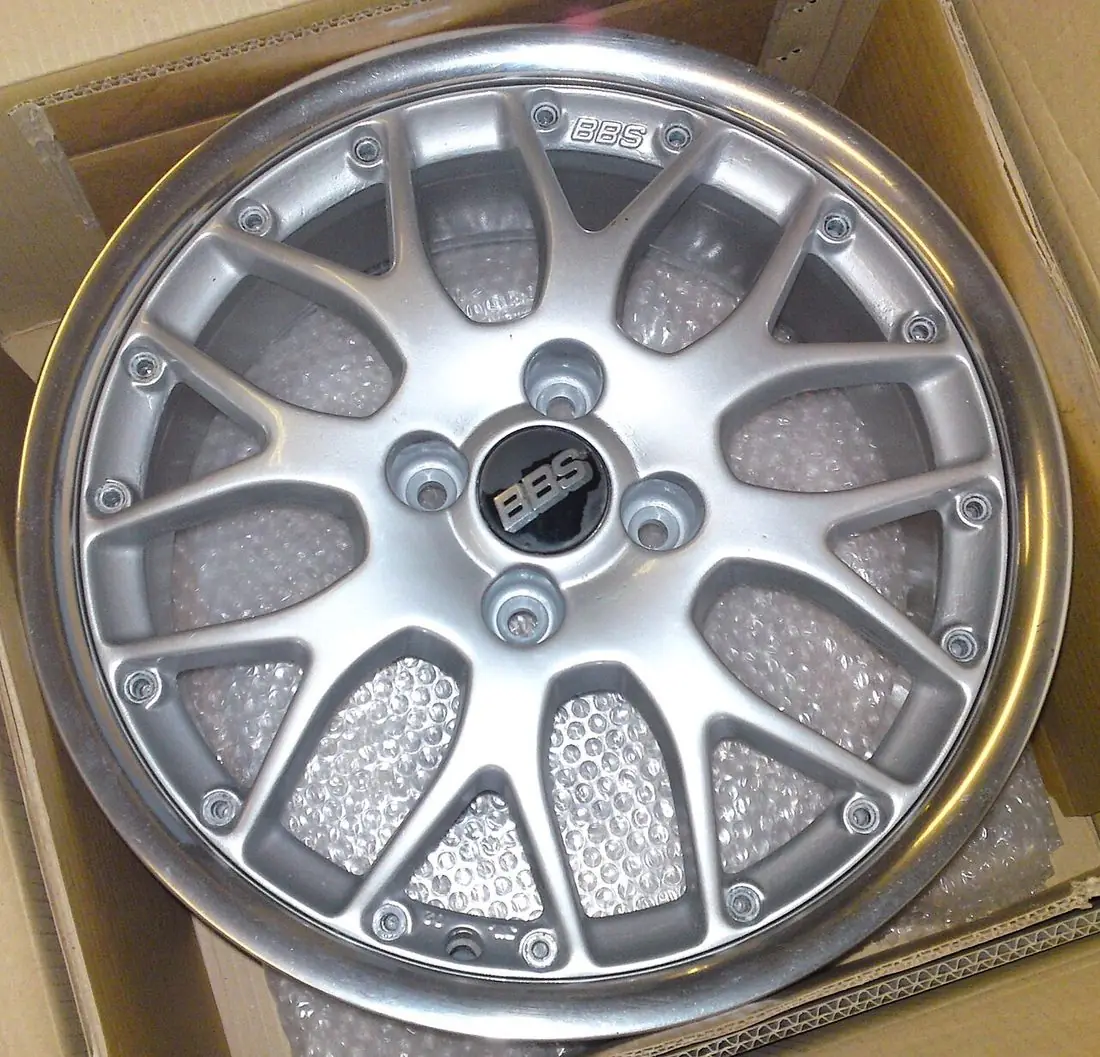
Two-piece mesh, UK
BBS RS II wheels in the UK: choosing by part number
The RS II carried the BBS mesh face over to two-piece construction in 17 and 18 inch sizes, and our tables list 174 part numbers for it. A good share suit cars that are common in Britain: BMW E36, E46, Z3 and Z4 in 5x120, Porsche 993 and 996 in 5x130, Volvo 850 and V70 in 5x10⁸, and a Golf Mk4 Cabriolet size in 4x100. With that many variants, the number on the back of the centre tells you far more than a listing photo.
- Era
- 1990s onward
- Construction
- Two-piece: mesh centre bolted into a one-piece rim
- Design
- Cross-spoke mesh centre
- Predecessor
- BBS RS (three-piece)
- Typical diameters
- Larger than the RS, commonly 16 to 18 inch; varies by market
- Identification
- Part number marked on the centre
Choosing an RS II in the UK
Begin with the size of your car's original wheels, from the handbook or the stamps on the factory rims, and look for RS II part numbers near those figures.
Numbers for cars common in Britain
- BMW: RS703 (8x17, 5x120, ET40) is listed for the E30 M3, E36, E28 and Z3. RS801 and RS802 are listed for the E46 and Z4 E85.
- Porsche: RS773 and RS774 are listed for the 993 and 996.
- Volvo: RS768 (7x17, 5x10⁸) is listed for the 850, V70 and S70.
- VW: RS764 (6.5x16, 4x100) is listed for the Golf Mk4 Cabriolet.
- Japanese cars: RS835 (7.5x17, 5x114.3) is listed for Toyota, Honda and Mazda, and RS838 and RS839 for Nissan, with no models named.
A lot of 5x114.3 rows have no fitment note, so confirm the centre bore and offset yourself.
Bigger sizes, MOT and insurance
Moving up a diameter or fitting wider rears changes where the tyre sits in the arch. Nothing in the UK needs approving, but the MOT fails tyres that foul the body or suspension, and the set has to be declared to your insurer. Keep the rolling diameter near the original so the speedometer reads true. The fitment and offset guide goes through the maths.
Salt, grit and the centre joint
An RS II has fewer seals than a three-piece RS, but its centre-to-rim joint still collects dirt. Winter salt gets under the paint at the bolt heads and shows up as bubbling, and potholes can bend a barrel. Rinse the wheels often in winter with a pH-neutral cleaner, or keep the RS IIs for the warmer months and run a winter set. See caring for BBS wheels.
Finding a set
Try eBay UK, PistonHeads, Gumtree, Facebook Marketplace and the BMW, Porsche and Volvo club forums. Sets bought from the EU may add VAT and handling charges. The used buying guide lists the questions to put to a seller.
Why BBS followed the RS
By the 1990s the cars that had worn RS wheels in the 1980s had grown. Brakes were bigger, tyres were lower in profile, and buyers wanted 17 and 18 inch wheels. The three-piece RS had been designed around smaller diameters and a time when owners accepted more maintenance. A wheel that kept the mesh face but was easier to build and look after made sense.
The RS II was that wheel. It kept the visual idea that had made the RS popular, a fine cross-spoke centre with visible bolts around the edge, and moved to a two-piece layout. For buyers it meant fewer parts and fewer seals to go wrong, and the wheel could still be built in different widths and offsets. BBS had been founded in 1970 in Schiltach by Heinrich Baumgartner and Klaus Brand, and by this point it was a large supplier to car makers as well as the aftermarket. The RS II sat in the aftermarket range alongside wheels it also produced for factory fitment. See BBS history for the background.
Two-piece construction explained
A two-piece wheel has a centre and a single rim. On the RS II the mesh centre is fixed into the rim with a ring of bolts, and the rim itself is one part, with no joint between an inner and outer half. That removes the main sealing joint you find on a three-piece wheel.
The design still allows variety. The width and offset are decided by which rim is used and where the centre is mounted in it, so a single centre design could be built into many specifications. Compared with the RS, though, the options for changing a wheel later are narrower. You cannot swap one lip for a deeper one the way you can on a three-piece wheel. Changing the width means a different rim.
The bolts on the face of many RS II wheels are structural and hold the centre to the rim. On some two-piece wheels from various makers the visible bolts are decorative, so do not assume either way. Check how the wheel you are looking at is put together. Our guide to forged and cast BBS wheels explains how construction methods differ across the ranges.
Telling an RS II from an RS
From a distance the two look alike. Up close there are differences you can check:
- Look for a joint around the rim. An RS has a seam where the inner and outer halves meet. An RS II rim is one piece.
- Check the diameter. RS II wheels were generally made in larger sizes, so an 18 inch mesh BBS from the 1990s is more likely to be an RS II than an RS.
- Read the part number on the centre, which settles the question.
The centre caps can also differ, but caps are swapped so often that they are poor evidence. Mesh copies are very common, including copies of the RS II face. As with the RS, look at the back of the wheel. A genuine wheel has proper markings and real hardware, and copies often lack both. The later RS-GT is another two-piece mesh wheel that is sometimes confused with the RS II, and the original RS page covers the three-piece version.
Part numbers and markings
Like the RS, the RS II is catalogued by part number. The number is marked on the centre, and it identifies the specification the wheel was built to: diameter, width, offset, bolt pattern and centre bore. The variant tables on this page are organised by those numbers.
To find it, take the wheel off and clean the back of the centre. Brake dust and old balance weights can cover the markings. You may also find size information on the rim, test or approval marks that depend on the country of sale, and production details. Write everything down and photograph it before you go looking through tables.
If the numbers on a set do not match, the set has probably been put together from different sources. That is common with older wheels. Our page on identifying BBS wheels explains the markings used across BBS ranges.
Sizes and fitment
RS II wheels were made in a broad range of sizes, with 17 and 18 inch diameters common, and in the bolt patterns used by the car makers of the time, including 5x112, 5x120 and others. Staggered sets with wider rears were offered for rear-drive cars. The tables list the specification for each part number.
When matching a set to a car:
- Confirm the bolt pattern and centre bore. Hub rings may be needed if the bore is larger than the hub.
- Check the offset against what your car needs. Wheels built for one model can sit too far in or out on another.
- Check brake clearance, especially with aftermarket or later factory brakes.
- Use the correct bolts or nuts for the seat of the wheel.
The fitment and offset guide covers how width, offset and tyre size work together.
Choosing a specification for your car
Because the RS II was built in so many specifications, the right wheel for one car can be wrong for another that looks similar. Start with what your car came with from the factory: the original diameter, width, offset and bolt pattern, which are usually in the owner's handbook or on a placard in the door shut or fuel flap. Then look for RS II part numbers close to those figures.
A wheel that is one inch larger in diameter usually needs a tyre with a lower profile to keep the overall rolling diameter similar, which keeps the speedometer reading and the ride height close to standard. Going wider is where most problems start. Extra width on the outside of the wheel moves the tyre toward the wing, and extra width on the inside moves it toward the suspension. Offset decides how that extra width is split. A few millimetres can be the difference between a wheel that fits and one that rubs on full lock or under compression.
If you are building a staggered set for a rear-drive car, check the front and rear specifications separately, and make sure you are happy that the wheels cannot be rotated front to rear. On cars with factory staggered sizes, matching the original front and rear offsets is a sensible starting point. Lowered cars need more care, because the tyre moves up into the arch where the gap to the wing lip is narrowest.
Buying RS II wheels used
Most RS II wheels on the market are second-hand and many have been refinished at least once. Ask for clear pictures of the backs so you can see the part numbers and the inside of the rim. A seller who will not show the backs is a reason to be cautious.
Look for kerb damage on the outer edge, cracks or bends on the inner barrel, and corrosion around the bolts that hold the centre in place. Paint bubbling around bolt heads often means moisture has got under the finish. A slow air leak can come from the joint between the centre and rim, from a damaged bead seat or from a valve. Spinning the wheels on a balancer will show up bends that photos hide.
Make sure the sizes suit your car before you buy, because a set built for a different model may need spacers or may not work at all. The used buying guide has more detail.
Refurbishing an RS II
The two-piece layout makes refurbishment a little simpler than on an RS. A thorough job usually involves separating the centre from the rim, stripping and refinishing both parts, replacing the assembly hardware and resealing. The wheel is then leak-tested and balanced. Some refurbishers will refinish the wheel assembled, which is less costly but cannot treat corrosion hidden between the centre and rim.
As with any bolted wheel, the hardware should be tightened evenly to the right torque. Use a refurbisher who has worked on two-piece and three-piece wheels before. Much of what is in our guide to refurbishing three-piece wheels also applies here.
Everyday care
The mesh face holds brake dust, so clean it regularly with a pH-neutral cleaner and a soft brush. Avoid harsh acid products, which can attack the finish and the hardware. While you are cleaning, look at the bolt heads for corrosion and check that none are missing.
Keep an eye on tyre pressures. A wheel that needs topping up more often than the others may have a seal starting to fail, and that is easier to fix early. If you store the wheels, clean and dry them first. See caring for BBS wheels for more.
How to use the variant listings
The tables below this introduction list RS II specifications by part number. Use them to work out what a wheel was built for, or to find a part number that matches your car. Always measure a wheel you are buying, because refinishing and repairs can change things like centre bore if hub rings have been fitted, and sets are often mixed. For other mesh designs, see the RS, the RS-GT and the full list of rim models.
Photographed models
1 of 174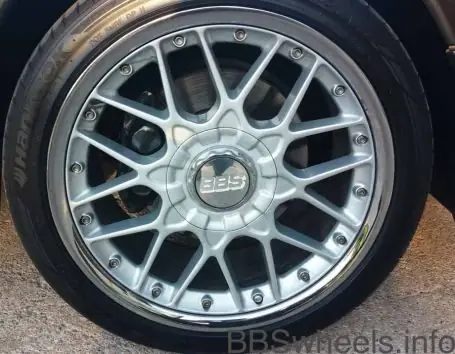

All BBS RSII models
174 models| Model | Size | PCD | Offset | CB (mm) | Fitment |
|---|---|---|---|---|---|
| BBS RS700 | 8.5x18" | 5x120 | ET22 | — | BMW |
| BBS RS701 | 10x18" | 5x120 | ET25 | — | BMW |
| BBS RS702 | 8x17" | 5x112 | ET35 | — | vag |
| BBS RS703 | 8x17" | 5x120 | ET40 | 72.5 | BMW M3(E30),E36,E28,Z3 |
| BBS RS704 | 8.5x18" | 5x112 | ET22 | — | — |
| BBS RS705 | 10x18" | 5x112 | ET20 | — | — |
| BBS RS706 | 8.5x18" | 5x130 | ET45 | — | Porsche 993, turbo |
| BBS RS707 | 10x18" | 5x130 | ET50 | — | Porsche 993, turbo |
| BBS RS708 | 9x20" | 5x120 | ET22 | — | BMW |
| BBS RS709 | 10x20" | 5x120 | ET25 | — | BMW |
| BBS RS710 | 8.5x18" | 5x112 | ET32 | — | vag |
| BBS RS711 | 10x18" | 5x112 | ET40 | — | vag |
| BBS RS712 | 8x17" | 5x114.3 | ET38 | — | — |
| BBS RS713 | 8x17" | 5x120 | ET15 | 72.5 | BMW E34,E24,E31,E32,E38 |
| BBS RS714 | 8.5x18" | 5x120 | ET38 | 72.5 | BMW e36, Z3 |
| BBS RS715 | 7x17" | 4x100 | ET35 | — | — |
| BBS RS716 | 7x17" | 4x114.3 | ET40 | — | — |
| BBS RS717 | 8.5x18" | 5x114.3 | ET40 | — | — |
| BBS RS718 | 10x18" | 5x114.3 | ET45 | — | — |
| BBS RS719 | 8.5x18" | 5x120.65 | ET28 | 73.9 | Jaguar XJ, XJ-R |
| BBS RS720 | 8x18" | 5x130 | ET50 or 52 | — | Porsche 991, 993, 996, 964 |
| BBS RS721 | 10x18" | 5x130 | ET65 | — | Porsche 991, 993, 996, 964 |
| BBS RS722 | 7x16" | 5x100 | ET43 | 57 | — |
| BBS RS723 | 7.5x17" | 5x120 | ET41 | 72.5 | BMW e36, Z3 |
| BBS RS724 | 8.5x17" | 5x120 | ET41 | 72.5 | BMW e36, Z3 |
| BBS RS725 | 8x18" | 5x114.3 | ET40 | — | — |
| BBS RS726 | 9x18" | 5x114.3 | ET45 | — | — |
| BBS RS727 | 8x18" | 5x114.3 | ET35 | — | — |
| BBS RS728 | 9x18" | 5x114.3 | ET35 | — | — |
| BBS RS729 | 7x17" | 5x114.3 | ET42 | 73 | — |
| BBS RS730 | 7x17" | 5x114.3 | ET35 | 73 | — |
| BBS RS731 | 8x17" | 5x114.3 | ET42 | 73 | — |
| BBS RS733 | 8x17" | 5x114.3 | ET36 | — | — |
| BBS RS734 | 9x17" | 5x114.3 | ET48 | — | — |
| BBS RS735 | 9x17" | 5x114.3 | ET39 | — | — |
| BBS RS736 | 9x17" | 5x114.3 | ET39 | — | — |
| BBS RS737 | 9x17" | 5x114.3 | ET26 | — | — |
| BBS RS738 | 10x17" | 5x114.3 | ET52 | — | — |
| BBS RS740 | 8x17" | 5x120 | ET20 | — | BMW |
| BBS RS741 | 9x17" | 5x120 | ET26 | — | BMW |
| BBS RS742 | 8x18" | 5x120 | ET20 | 72.5 | BMW e38 |
| BBS RS743 | 9.5x18" | 5x120 | ET25 | 72.5 | BMW e38 |
| BBS RS744 | 8x18" | 5x120 | ET20 | 74.1 | BMW e39 |
| BBS RS745 | 9x18" | 5x120 | ET24 | 74.1 | BMW e39 |
| BBS RS746 | 7x17" | 4x114.3 | ET42 | 73 | — |
| BBS RS748 | 8x17" | 5x114.3 | ET38 | — | — |
| BBS RS749 | 8x17" | 5x114.3 | ET43 | 73 | — |
| BBS RS750 | 9x17" | 5x114.3 | ET47 | 73 | — |
| BBS RS751 | 8x17" | 5x114.3 | ET35 | — | — |
| BBS RS752 | 9x17" | 5x114.3 | ET37 | — | — |
| BBS RS753 | 7x17" | 5x100 | ET50 | 56 | — |
| BBS RS755 | 8x18" | 5x114.3 | ET42 | — | — |
| BBS RS756 | 8x18" | 5x114.3 | ET36 | — | — |
| BBS RS757 | 8x18" | 5x114.3 | ET48 | — | — |
| BBS RS758 | 9x18" | 5x114.3 | ET42 | — | — |
| BBS RS759 | 9x18" | 5x114.3 | ET36 | — | — |
| BBS RS761 | 10x18" | 5x114.3 | ET52 | — | — |
| BBS RS763 | 7.5x18" | 5x10⁸ | ET43 | 65.1 | Volvo |
| BBS RS764 | 6.5x16" | 4x100 | ET45 | 57 | VW / "Jubis " / Golf 4 Cabrio |
| BBS RS765 | 8x17" | 5x120 | ET47 | 72.5 | BMW e36 |
| BBS RS767 | 7.5x17" | 5x10⁸ | ET42 | 65.1 | Volvo |
| BBS RS768 | 7x17" | 5x10⁸ | ET37 | 65.1 | Volvo 850 V70 S70 |
| BBS RS769 | 8x17" | 5x100 | ET35 | 57 | vag |
| BBS RS770 | 8x17" | 5x98 | ET25 | — | — |
| BBS RS771 | 6.5x16" | 5x100 | ET42 | 57 | vag |
| BBS RS772 | 6x15" | 4x100 | ET45 | 57 | vag |
| BBS RS773 | 7.5x18" | 5x130 | ET50 | — | Porsche 993, 996 |
| BBS RS774 | 9x18" | 5x130 | ET52 | — | Porsche 993, 996 |
| BBS RS775 | 7x17" | 4x114.3 | ET42 | — | — |
| BBS RS776 | 7x17" | 5x100 | ET48 | — | — |
| BBS RS777 | 7x17" | 5x114.3 | ET35 | — | — |
| BBS RS778 | 7x17" | 5x114.3 | ET45 | — | — |
| BBS RS779 | 8x17" | 5x114.3 | ET38 | 70 | — |
| BBS RS780 | 8x17" | 5x114.3 | ET45 | — | — |
| BBS RS781 | 9x17" | 5x114.3 | ET38 | 70 | — |
| BBS RS782 | 9x17" | 5x114.3 | ET45 | — | — |
| BBS RS783 | 7.5x18" | 4x114.3 | ET45 | — | — |
| BBS RS784 | 7.5x18" | 5x100 | ET48 | — | — |
| BBS RS785 | 7.5x18" | 5x114.3 | ET45 | — | — |
| BBS RS786 | 8x18" | 5x114.3 | ET35 | — | — |
| BBS RS787 | 8x18" | 5x114.3 | ET40 | — | — |
| BBS RS788 | 9x18" | 5x114.3 | ET35 | — | — |
| BBS RS789 | 9x18" | 5x114.3 | ET45 | — | — |
| BBS RS790 | 9.5x18" | 5x114.3 | ET20 | — | — |
| BBS RS792 | 7.5x17" | 5x10⁸ | ET43 | — | Volvo |
| BBS RS793 | 9x18" | 5x120 | ET47 | 72.4 | Land Rover |
| BBS RS794 | 7x16" | 5x100 | ET38 | 57 | VW |
| BBS RS795 | 8x18" | 5x112 | ET43 | — | vag |
| BBS RS796 | 6x15" | 5x100 | ET38 | 57 | VW |
| BBS RS797 | 7.5x17" | 5x10⁸ | ET43 | — | Volvo |
| BBS RS798 | 9x19" | 5x120 | ET48 | 72.5 | BMW x5 e53 |
| BBS RS799 | 10x19" | 5x120 | ET45 | 72.5 | BMW x5 e53 |
| BBS RS800 | 7.5x17" | 5x112 | ET45 | 57 | VW passat W8 |
| BBS RS801 | 8x18" | 5x120 | ET47 | 72.5 | BMW e46, z4 e85 |
| BBS RS802 | 8.5x18" | 5x120 | ET50 | 72.5 | BMW e46, z4 e85 |
| BBS RS803 | 8x18" | 5x100 | ET33 | 57 | vag, TT mk1 |
| BBS RS804 | 8x17" | 5x120 | ET23 | 72.5 | BMW e38 |
| BBS RS805 | 8.5x19" | 5x114.3 | ET38 | — | — |
| BBS RS806 | 9.5x19" | 5x114.3 | ET38 | — | — |
| BBS RS809 | 8x18" | 5x114.3 | ET35 | — | — |
| BBS RS810 | 8x18" | 5x114.3 | ET42 | — | — |
| BBS RS811 | 9x18" | 5x114.3 | ET35 | — | — |
| BBS RS812 | 9x18" | 5x114.3 | ET40 | — | — |
| BBS RS813 | 9.5x18" | 5x114.3 | ET14 | — | — |
| BBS RS814 | 6.5x15" | 4x100 | ET43 | 57 | VW lupo GTI |
| BBS RS815 | 7.5x17" | 5x114.3 | ET35 | — | — |
| BBS RS821 | 9.5x18" | 5x114.3 | ET15 | — | — |
| BBS RS822 | 8x18" | 5x10⁸ | ET49 | — | Volvo |
| BBS RS823 | 7.5x18" | 5x100 | ET45 | — | — |
| BBS RS824 | 7.5x18" | 5x114.3 | ET45 | — | — |
| BBS RS825 | 6.5x16" | 5x100 | ET43 | 57 | vag |
| BBS RS826 | 8x17" | 5x100 | ET35 | 57 | vag |
| BBS RS827 | 9x17" | 5x100 | ET32 | 57 | vag |
| BBS RS828 | 8x17" | 5x112 | ET32 | — | MB AMG/C/E/S, VAG |
| BBS RS829 | 9x17" | 5x112 | ET32 | — | MB AMG/C/E/S, VAG |
| BBS RS830 | 7x17" | 5x112 | ET50 | 66.5 | MB A |
| BBS RS831 | 8.5x17" | 5x120 | ET50 | 72.5 | BMW e36, e46, z3 |
| BBS RS832 | 8x17" | 5x110 | ET35 | 65.1 | Opel |
| BBS RS833 | 8x17" | 5x10⁸ | ET38 | 65.1 | Volvo |
| BBS RS834 | 7.5x17" | 5x98 | ET30 | 58 | Alfa Romeo |
| BBS RS835 | 7.5x17" | 5x114.3 | ET40 | — | toyota, honda, mazda |
| BBS RS836 | 8sx17" | 5x114.3 | ET40 | — | — |
| BBS RS837 | 9x17" | 5x114.3 | ET45 | — | toyota |
| BBS RS838 | 8x17" | 5x114.3 | ET30 | — | nissan |
| BBS RS839 | 9x17" | 5x114.3 | ET35 | — | nissan |
| BBS RS844 | 7x17" | 4x100 | ET48 | 56.1 | MINI Cooper R56 |
| BBS RS845 | 8x17" | 5x120 | ET20 | 74.1 | BMW e39 |
| BBS RS846 | 9x20" | 5x120 | ET24 | 72.5 | BMW e65 |
| BBS RS847 | 10x20" | 5x120 | ET24 | 72.5 | BMW e65 |
| BBS RS848 | 8x18" | 5x120 | ET47 | 72.5 | BMW e46, z4 e85 |
| BBS RS849 | 8.5x18" | 5x120 | ET50 | 72.5 | BMW e46, z4 e85 |
| BBS RS850 | 8x19" | 5x120 | ET20 | 72.5 | BMW e60 |
| BBS RS851 | 9.5x19" | 5x120 | ET32 | 72.5 | BMW e60 |
| BBS RS853 | 9x18" | 5x114.3 | ET28 | — | — |
| BBS RS854 | 9x18" | 5x114.3 | ET36 | — | — |
| BBS RS855 | 9x18" | 5x114.3 | ET37 | — | — |
| BBS RS857 | 10x18" | 5x114.3 | ET37 | — | — |
| BBS RS858 | 8.5x20" | 5x120 | ET14 | 72.5 | BMW e63 |
| BBS RS859 | 9.5x20" | 5x120 | ET20 | 72.5 | BMW e63 |
| BBS RS861 | 8.5x19" | 5x112 | ET48 | 57 | vag |
| BBS RS862 | 8x19" | 5x120 | ET37 | 72.5 | BMW e90 |
| BBS RS863 | 9x19" | 5x120 | ET39 | 72.5 | BMW e90 |
| BBS RS864 | 8x18" | 5x10⁸ | ET45 | — | Volvo |
| BBS RS865 | 9x19" | 5x112 | ET41 | 57 | vag |
| BBS RS866 | 7.5x18" | 5x112 | ET54 | 57 | vag |
| BBS RS868 | 7.5x17" | 5x112 | ET45 | 57 | vag |
| BBS RS873 | 7x17" | 4x100 | ET48 | 56.1 | MINI Cooper R56 |
Where a model has several size versions, the first is shown here; the model page lists them all.
Also catalogued without recorded specs
Frequently asked questions
Which RS II suits an E46?
Our tables list RS801 (8x18, ET47) and RS802 (8.5x18, ET50) in 5x120 for the E46 and Z4 E85, along with RS848 and RS849 in the same sizes. Check the numbers on the backs and make sure the spokes clear your brakes.
Where do I find my car's original wheel size?
The owner's handbook usually lists wheel and tyre sizes, and many cars carry a tyre pressure label in the door shut or fuel flap with the factory tyre sizes. The stamp on the back of an original wheel gives width and offset.
Do I have to tell my insurer about RS II wheels?
Yes. Non-standard wheels are a modification, and leaving them off your policy can void your cover. Most insurers just want the details before you fit them.
What is the difference between the BBS RS and RS II?
The RS is three-piece, with a centre between two separate rim halves. The RS II is two-piece, with the centre bolted into a one-piece rim. The RS II was generally made in larger diameters.
Can I change the width of an RS II?
Not as easily as on a three-piece wheel. Because the rim is one piece, changing the width means fitting a different rim.
Where do I find the RS II part number?
On the centre, usually on the back. Remove the wheel and clean off brake dust to read it.
Do RS II wheels leak?
Any bolted wheel can develop a leak at the centre joint with age. A refurbisher can reseal it.